Pu Luong, terraces and a lane network
Two valleys three hours west of Hanoi, floored with terraced rice and threaded with concrete lanes that no car can use. The best short cycling in Vietnam.
At a glance
| Where | Thanh Hoa and Hoa Binh provinces, 160 km west of Hanoi |
| Getting there | 3 hours by road, no train, no airport |
| Nights needed | 3 nights covers both valleys properly |
| Best months | September to November, and March to May |
| Avoid | June to August for mud; late July for heat and rain |
| Altitude | Valley floors 100 – 250 m, ridges to 900 m |
| Known for | Rice terraces, water wheels, stilt-house homestays |
| Ride it by | Bicycle — this is the best cycling terrain in the country |
What these valleys actually are
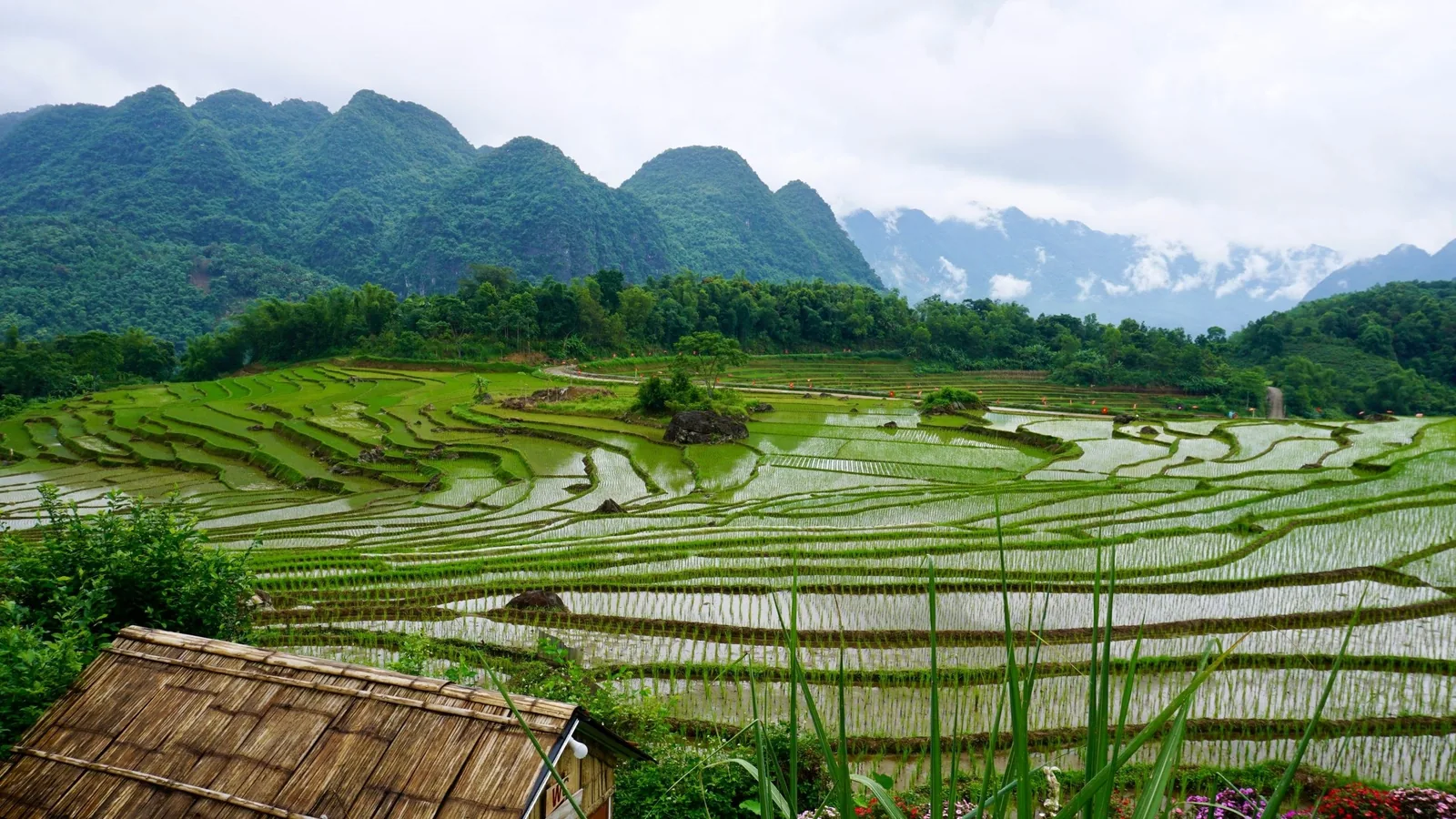
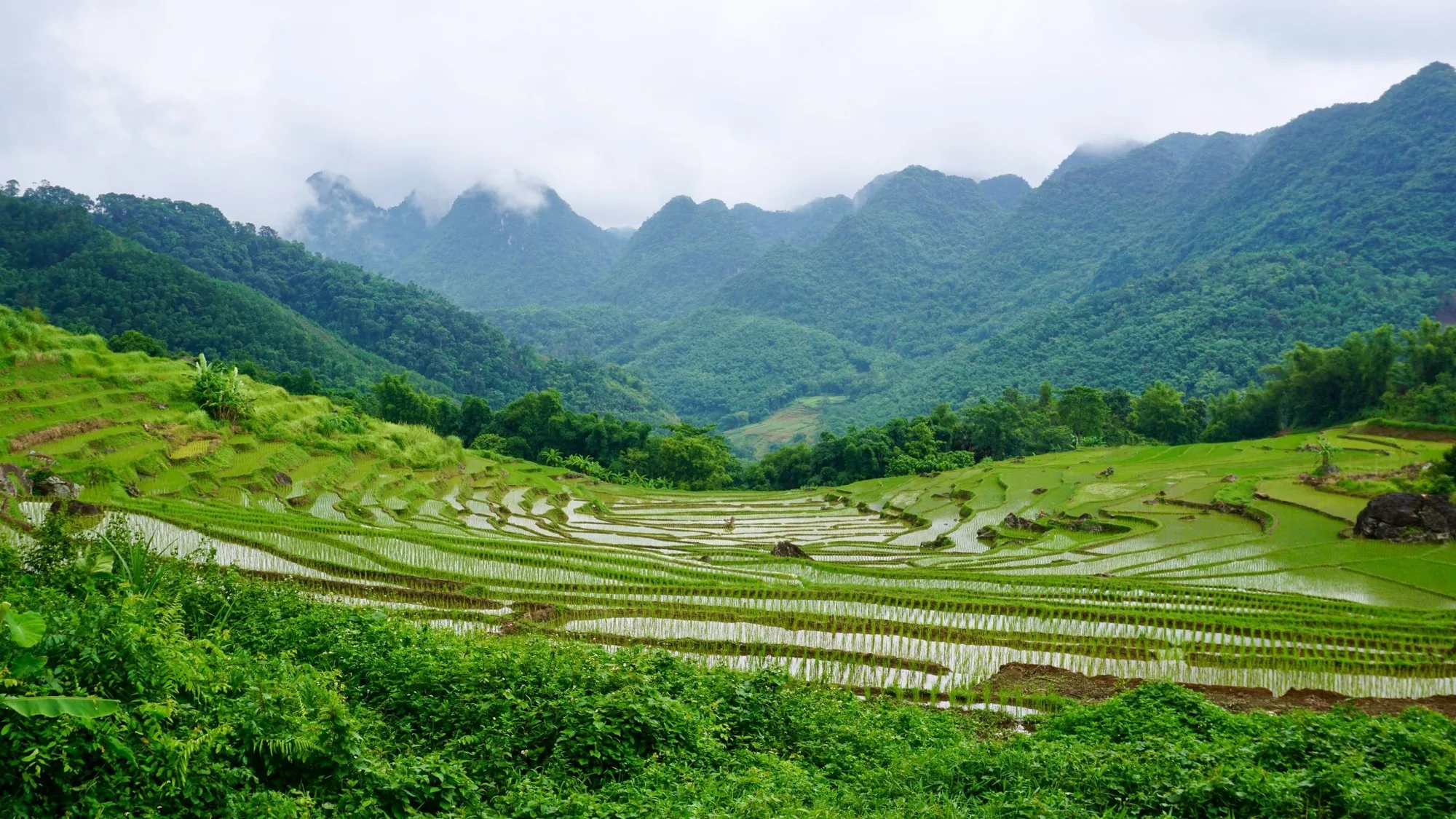
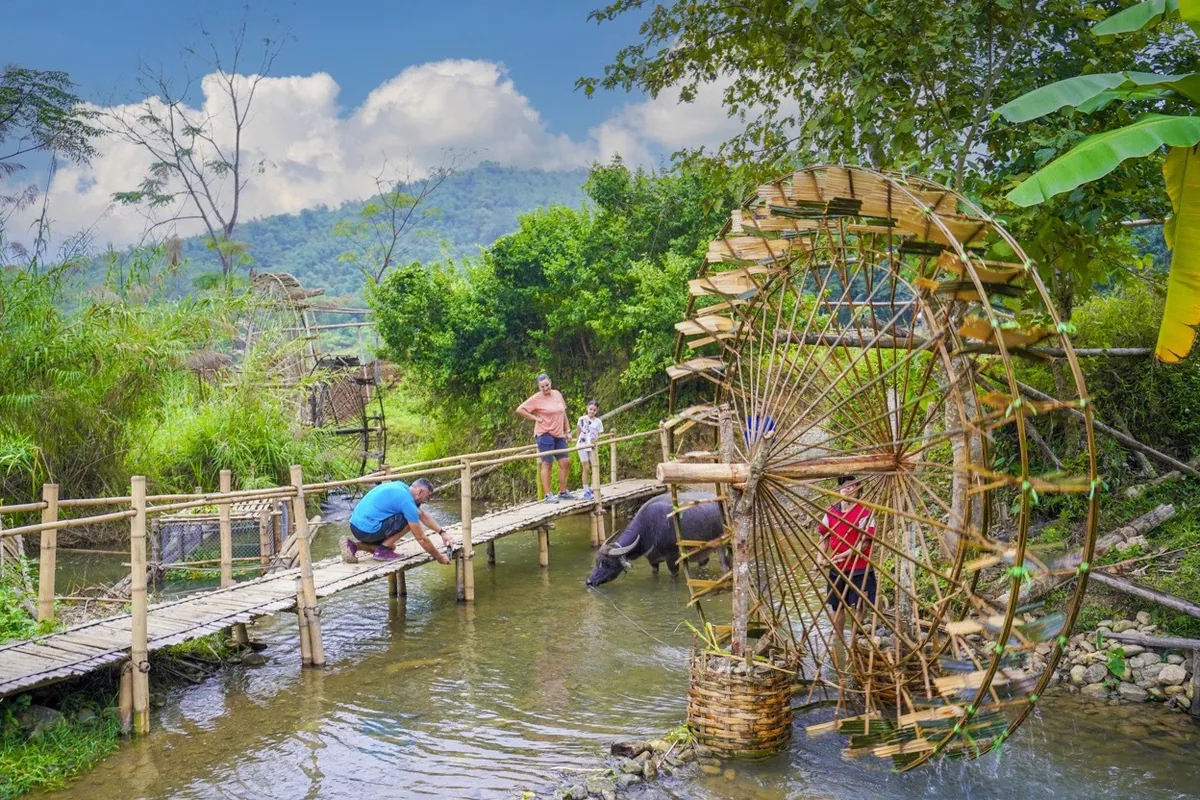
Mai Chau is a flat-floored valley about 8 km long, ringed by limestone, farmed by White Thai families who live in stilt houses. Pu Luong is the nature reserve on the other side of the ridge: steeper, higher, terraced up the hillsides, with bamboo water wheels lifting water from the river into the top terraces.
What makes both of them work for cycling is not the scenery, which the photographs handle. It is the lane network. Every hamlet is connected to every other by concrete lanes about a metre and a half wide, built for motorbikes and buffalo carts, and there are enough of them that you can ride four consecutive days without repeating a kilometre.
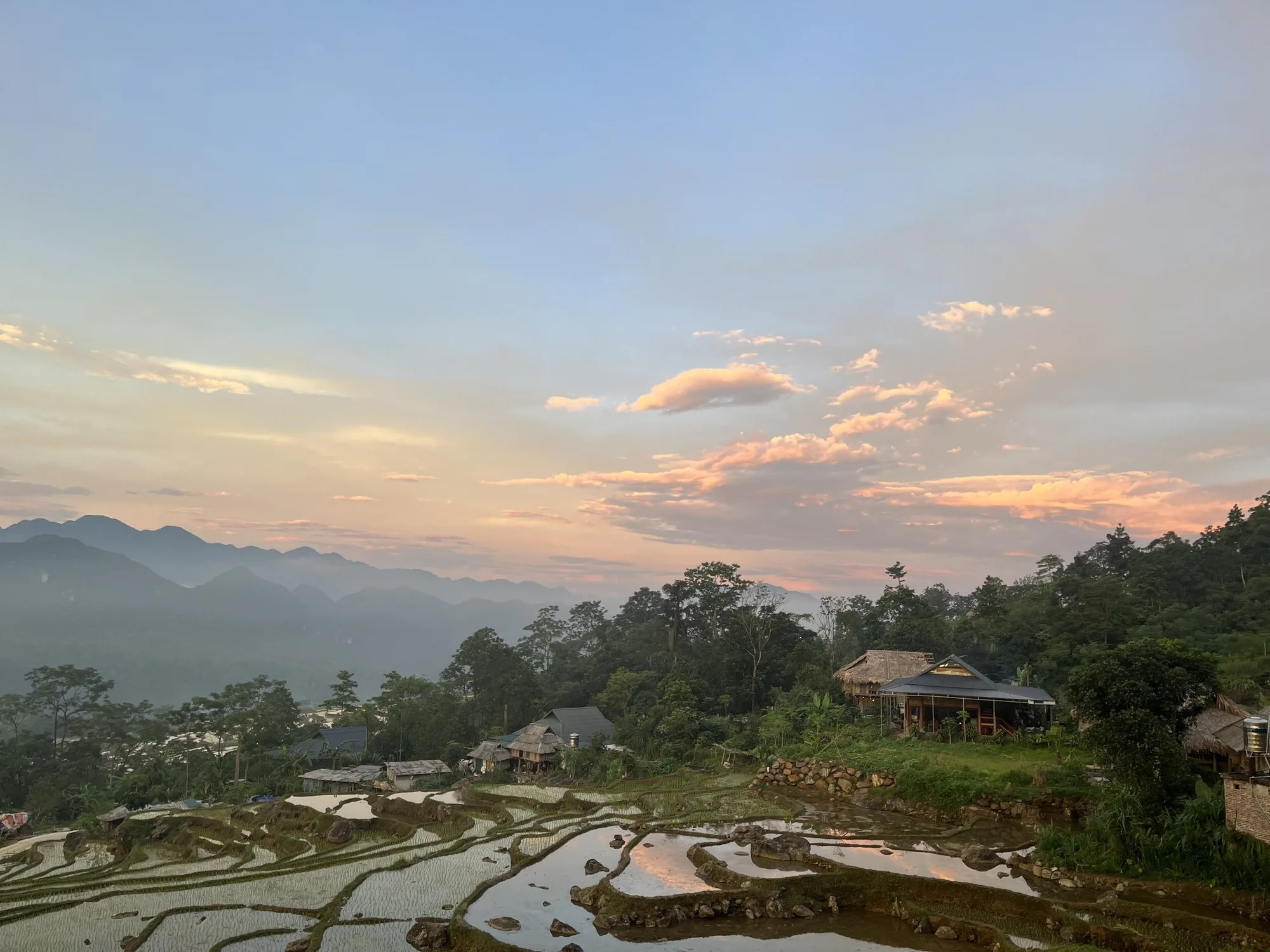
The honest part: Ban Lac, the main village in Mai Chau, has become a weekend destination for Hanoi. There is a car park, there are souvenir looms selling machine-woven scarves, and on a Saturday night there is amplified music. Twenty minutes' ride out of the village, none of that exists. Pu Luong is at an earlier stage — a dozen lodges have been built on the ridge in five years — and the valley floor is still farmed rather than staged.
How many nights, and why one is not enough
One night in Mai Chau is the standard Hanoi weekend trip, and it is six hours of driving for one afternoon. It is not worth it.
Three nights is the number: one in Mai Chau after riding over the Thung Khe pass, two in Pu Luong so that you get a full day riding the valley loop rather than arriving and leaving. That gives you four riding days and 180 km.
Four nights lets you add the Ban Cong and Son Ba Muoi side of the reserve, which is higher, colder and has almost no visitors. It is where our guides go on their own days off, which is the strongest recommendation available.
When to go, month by month
| Months | The terraces | Riding conditions | Verdict |
|---|---|---|---|
| Sep – early Oct | Gold, the two-week harvest window | Dry, 22 – 30°C | The best fortnight of the year |
| Oct – Nov | Cut and brown, clear air | Dry, 18 – 27°C | Excellent and quieter |
| Dec – Feb | Bare, misty mornings | Cool, 9 – 20°C, damp | Good riding, poor photographs |
| Mar – Apr | Ploughed, then planted | Warm, 20 – 30°C, clear | Second-best season |
| May – Jun | Water mirrors after planting | Hot, 26 – 35°C, showers | Beautiful and hard work |
| Jul – Aug | Deep green, full growth | Wet, 26 – 34°C, mud | Avoid if you can |
The gold window in late September moves by a week or two each year with the planting, and nobody can tell you the exact dates in March. If the photographs are the point of your trip, book the last week of September and accept a small risk of being early.
The wet months are not unrideable — the sealed lanes drain fast — but the dirt sections turn to clay and the water wheels are hidden by a full river. It is the one season where the valley looks better in life than in photographs.
Getting there and moving around
| Option | Time | Cost | Notes |
|---|---|---|---|
| Private car from Hanoi, up to 4 | 3 h to Mai Chau, 4 h to Pu Luong | USD 85 – 130 each way | The only sensible option with bikes |
| Public bus to Mai Chau | 4 h | USD 5 – 8 | Frequent, no bike carriage |
| Limousine van, door to door | 3 h 30 | USD 14 – 20 | Book a day ahead |
| Motorbike from Hanoi | 4 h | Fuel only | Busy road out of the city, not recommended |
There is no railway and no airport. Within the valleys, everything is walking or riding distance, and a bicycle is genuinely faster than a car on the lanes.
What things cost
| Item | Typical price |
|---|---|
| Stilt-house homestay, platform bed, dinner and breakfast | USD 12 – 20 |
| Homestay private room with bathroom | USD 22 – 38 |
| Valley lodge, fan room, Pu Luong | USD 45 – 75 |
| Valley lodge, bungalow with a view and a pool | USD 85 – 150 |
| Dinner at a homestay, shared, several dishes | USD 5 – 9 |
| Lunch at a roadside restaurant | USD 3 – 6 |
| Bicycle hire locally, basic | USD 5 – 10 per day |
| Pu Luong reserve entrance | USD 2 |
Bring cash. There is an ATM in Mai Chau town and one in Canh Nang; inside the reserve there is nothing, and the lodges that take cards charge a 3 per cent fee for it.
Photographs
When to skip these valleys
- If you only have two days. Six hours of driving for one afternoon of riding is a bad trade. Ride the Red River dykes out of Hanoi instead.
- If you need air conditioning and a lift. Most homestays and the standard lodge rooms have neither. From May to September that is a real consideration.
- If you are coming for hill tribe culture specifically. The White Thai villages here are welcoming and well used to visitors. For a less mediated experience, Ha Giang and the far northwest are further along that scale.
- If you want a resort. There are now several comfortable lodges with pools in Pu Luong, and they are good. They are not resorts and the roads to them are single-lane concrete.
- In July and August, unless mud is part of the appeal.
Riding Pu Luong with us
Our four-day cycling route rides the Thung Khe pass into Mai Chau, crosses the ridge into Pu Luong on the hardest day, spends a full day on the valley loop and rides out on the eastern road. 182 km, 2,750 m of climbing, three nights.
Mai Chau and Pu Luong, 4 days — day distances, hotel names and prices. The same valleys also form days four to six of the fourteen-day route.
Ask about the valleys
Tell us your month and how many are riding, and we will say whether the terraces will be gold, green or brown when you get there.
Questions travellers ask most
Is Pu Luong better than Sa Pa for cycling?
Yes, clearly, and not because it is more beautiful — Sa Pa's valley probably is. It is because the lane network is denser and the roads have almost no traffic.
Sa Pa's riding is on two or three main roads shared with buses and construction lorries. Pu Luong's is on fifty kilometres of lanes that no car can enter.
Can beginners ride here?
On the valley floors, yes, comfortably. Mai Chau's floor is flat and Pu Luong has a low loop of about 25 km.
The connecting rides between the valleys are not beginner riding: 1,150 m of climbing in 62 km, on a lane that touches 14 per cent in short pitches. That is what the support vehicle is for, and using it is normal.
What is a stilt-house homestay actually like?
A single long room on the upper floor of a wooden house, with mattresses, pillows and mosquito nets laid out in a row, usually for eight to sixteen people. Bathrooms are downstairs and shared. It is clean and it is not private.
Dinner is cooked by the family and eaten together on the floor, and rice wine will be offered. If you would rather have a private room with a bathroom, most homestays now have two or three, and we book those when you ask.
Are there leeches or snakes?
Leeches, yes, in the wet season on the forest paths in the reserve — not on the roads and lanes where you will be riding. Long socks solve it.
Snakes exist and you will almost certainly not see one. In eleven seasons our guides have had two encounters worth reporting, both with the snake leaving faster than the rider.
Read next
Tell us about the ride you have in mind
Dates, party size and the places you care about are enough to start. You get a draft route and an indicative price, not a brochure.